Career Change CV: How to Write a CV for a New Career
Changing careers? How to write a career change CV that shows the new employer why your past work fits, without stretching the truth.

Alexander Phillip
Career Coach and Recruitment Expert
Short answer: a career change CV opens with a profile that names the job you want and the skills you bring to it, then shows your transferable skills and any new training before your work history. Keep your real job titles, and rewrite each bullet to stress the parts of your past work that the new job needs.
A career change CV (or career change resume) has one job: to make a recruiter in a new field see the fit in the first few lines. Here is how to write one.
What makes a career change CV different
A standard CV lets your job titles tell the story. When you change careers, your titles point the wrong way, so the top of your CV has to do the explaining: a clear profile, a skills section shaped for the new job, and proof that you have started (a course, a project, volunteering).
How to write a career change CV in 6 steps
1. Choose one target job
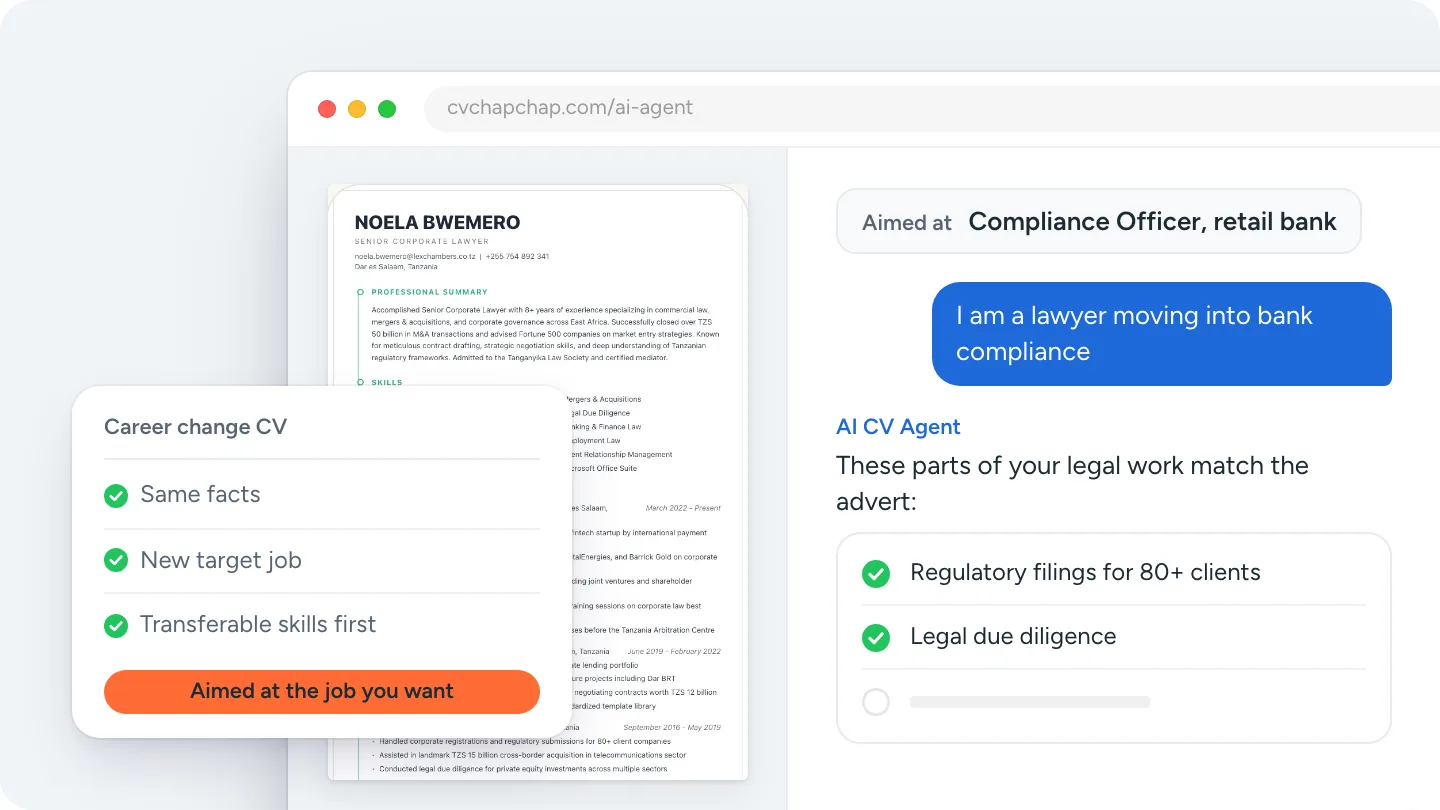
Pick a specific role, such as "compliance officer in a bank", not "something in finance". Read three or four real adverts for it and note the skills that repeat.
2. Write a profile that names the move
Say what you are now, what you bring and what you want, in two or three lines. Do not open with the new job title as if you already hold it.
Corporate lawyer with eight years of regulatory filings and due diligence for banks and telecoms, moving into bank compliance. Strong on reading regulations closely and explaining them plainly.
(This example is based on Noela, the fictional lawyer in our CV samples.) More examples in our CV personal profile guide.
3. Lead with transferable skills
Put a skills section near the top with the skills from the adverts that your past work truly shows. Teaching gives you training and presenting; retail gives you sales and customer care; nursing gives you record keeping and calm under pressure. Our guide to skills to put on a CV lists both soft and technical skills.
4. Add new training and projects
Courses, certificates, a portfolio, volunteering or freelance work in the new field go above your older experience. They prove you have already started.
5. Keep your job titles, reword the bullets
Never change a past job title to match the new field; an employer can check it. Instead, move the most relevant bullets to the top of each job and describe them in the new field's words where they mean the same thing. See action verbs for strong, honest openings.
6. Tailor it to each advert
Each application gets its own version. Our guide to tailoring your CV walks through it.
Which CV format is best for a career change?
A hybrid (combination) format: profile, then skills, then work history newest first. It puts your transferable skills up front without hiding your dates, which recruiters distrust. Our best CV format guide compares the options.
Career change CV example: teacher to trainer
- Profile: Secondary school teacher with seven years of planning and delivering lessons to groups of 40, moving into corporate training.
- Skills: Training design, presenting, assessment, coaching, Microsoft PowerPoint.
- Training: a training and facilitation certificate, if you have earned one.
- Experience bullet: "Planned and taught a two-year business studies course to classes of up to 40 students."
(A fictional example; use your own real numbers.) For more layouts see our CV examples.
Should I explain my career change on my CV?
Briefly, in the profile, and in more depth in your cover letter. The letter is the right place for why you are changing; our free cover letter generator helps you write it.
How the AI CV Agent helps with a career change
Paste the advert for the job you want into the AI CV Agent and it keeps that job in view for the whole conversation, shaping your summary and bullets for it. It will not open your summary with a job title you have never held, and it will not add an advert skill you never said you have, so your career change CV stays true.
A strong career change CV does not hide where you have been: it shows, honestly and early, why that experience fits where you are going.
Have the advert for your new career? Build your CV with the AI CV Agent.
Frequently Asked Questions
How do I write a CV for a career change?
Open with a profile that names the job you want and what you bring, put transferable skills and new training near the top, keep your real job titles, and reword your bullets to stress what the new job needs.
What is the best CV format for a career change?
A hybrid format: profile, skills, then work history newest first. It shows transferable skills first without hiding your dates.
What should a career change CV personal statement say?
What you do now, the skills you bring that the new job needs, and the role you want, in two or three honest lines.
Can I change my job titles on a career change CV?
No. Keep your real job titles; employers can check them. Change the order and wording of your bullets instead.
What are transferable skills on a CV?
Skills from your past work that a new job also needs, such as training, customer care, budgeting, writing, planning or data analysis.
Should I explain a career change in my cover letter?
Yes. Mention the move briefly in your CV profile and explain why, and why this job, in your cover letter.
Ready to Create Your Professional CV?
Put these tips into practice. Build a stunning, ATS-friendly CV in under 3 minutes with CV Chap Chap.
Create Your CV Now