CV After a Career Break: How to Explain the Gap and Get Interviews
Raising children, caring, illness, travel or redundancy: a career break is not a CV problem if you handle it in one honest line. How to write it, with an example.

Alexander Phillip
Career Coach and Recruitment Expert
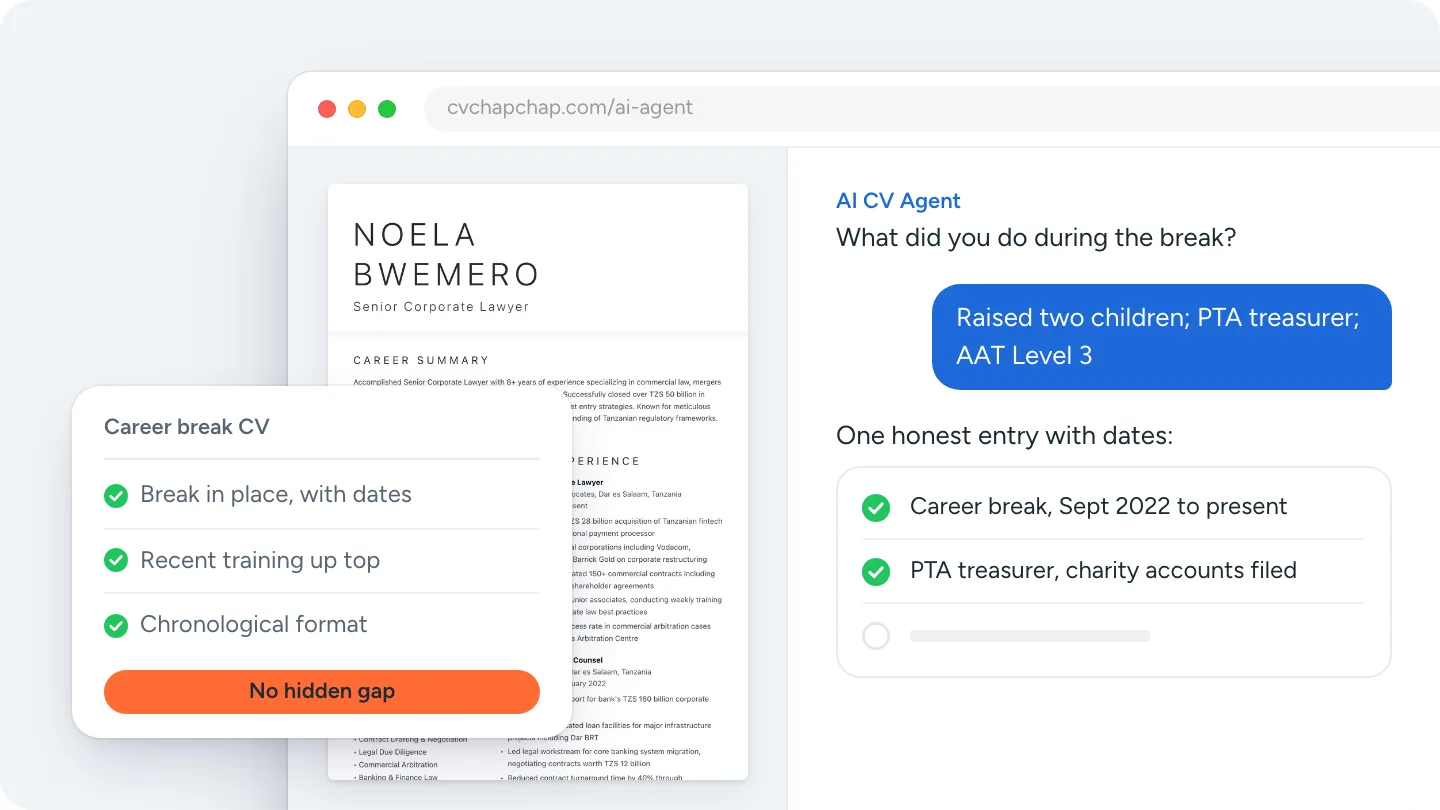
Short answer: on a CV after a career break, put the break in your experience section as its own entry with dates and a one-line reason, exactly where a job would go: "Career break, 2022 to 2026: raised two children; completed a Level 3 bookkeeping course and ran the PTA accounts." Keep a chronological CV, do not hide the gap with years-only dates, lead with a profile that names the role you are returning to, and give the time away one or two honest achievements. Recruiters see career breaks every day; what they distrust is a gap with no explanation.
This guide covers where the break goes, how to word it for different reasons (children, caring, illness, redundancy, travel, study), what to show from the time away, which CV format to use, and ends with an example CV for returning to work.
Where does a career break go on a CV?
In the experience section, in date order, as an entry with a title, dates and one or two lines. This keeps your timeline honest and lets the reader move on. Three things make it work:
- A clear title: "Career break", "Parental leave", "Full-time carer", "Career break for study". No euphemisms.
- Months or years, like every other entry: if the rest of your CV uses "March 2019", the break does too. Switching to years only to blur the dates is noticed.
- One line of reason and one of what you did: the reason is for context; what you did is evidence you kept moving.
How to word a career break on a CV
- Children: "Career break, September 2022 to present: full-time parent to two children. Treasurer of the school PTA (budget about 8,000 pounds a year); completed AAT Level 3 Bookkeeping, 2025."
- Caring: "Full-time carer, 2023 to 2025: cared for my father through his final illness, including managing his finances, medication and care agency contracts."
- Illness: "Career break for health reasons, 2024 to 2025, now fully resolved." You do not have to name the illness.
- Redundancy and job search: "2025 to present: career break following redundancy; completed a Google Data Analytics certificate and volunteered two days a week with Citizens Advice."
- Travel or a sabbatical: "Career break, 2024: twelve months travelling in South America; taught English in Cusco for four months."
- Study: put it under education with the dates; it is not a gap.
Keep it factual and short. A cover letter is the place for a sentence more; our free cover letter generator drafts it from your CV.
What to show from the time away
Anything that shows you kept skills current or built new ones:
- Courses and certificates, with the provider and year.
- Volunteering with a responsibility: treasurer, trustee, coordinator, coach.
- Freelance, consulting or part-time work, even a few hours a week.
- Running a household budget, a renovation, a family business or a parent's affairs: real project and financial management.
- Keeping professional memberships, licences or registrations active.
If the honest answer is "nothing", say less rather than inventing something, and spend the next month on a short course or volunteering you can add.
Which CV format is best after a career break?
A standard reverse-chronological CV with the break entered in place. Skills-based (functional) CVs that hide dates make recruiters suspicious and are hard for screening software to read; our guide to ATS-friendly CVs explains why. Put a strong profile and a short "Key skills" block at the top so the reader sees what you offer before the dates. If the break was long, a short "Recent training" section above the experience works well. Two pages is fine; our guide to how long a CV should be has the rules.
Career break CV example
Sarah is fictional; the example shows the break entry in place.
Sarah Jenkins
Bristol · 07xxx xxx xxx · sarah.jenkins@email.com · linkedin.com/in/sarahjenkins-exampleProfile
Finance assistant with six years in accounts payable and month-end for a manufacturing group, returning to work after a four-year career break. AAT Level 3 qualified (2025), confident on Sage and Excel, and available for full-time or four-day roles from September.Recent training
AAT Level 3 Diploma in Accounting, 2025 · Sage 50 refresher, 2026Experience
Career break, September 2022 to present
Full-time parent to two children. Treasurer of Henleaze Primary PTA since 2023: annual budget of about 8,000 pounds, monthly reports to the committee, charity accounts filed on time each year.Finance assistant, Avon Engineering Group, Bristol, 2016 to 2022
· Processed about 600 supplier invoices a month in Sage and resolved queries with suppliers and buyers.
· Prepared the monthly accruals schedule and supported the year-end audit.
· Introduced a shared invoice tracker that cut duplicate payments in my area to zero in 2021.Education
BA Business Studies, University of the West of England, 2016Skills
Accounts payable · Month-end accruals · Sage 50 · Excel (lookups, pivot tables) · Supplier queries · Charity accounts
Want the AI CV Agent to write your break entry and profile with you? Build your CV with the AI CV Agent.
Questions about career break CVs
Should I explain a career break on my CV?
Yes, in one line with dates. An unexplained gap raises more questions than any reason you could give, and recruiters are used to breaks for children, caring, health and redundancy.
How far back should a CV go after a career break?
Ten to fifteen years of detail is enough for most roles; summarise older jobs in a line each. The break is recent, so it needs the clearest entry, not the longest.
Are there employers who want returners?
Yes. Some UK employers run returner programmes (sometimes called returnships) aimed at people coming back after a break of a year or more, and organisations such as Career Returners list them. Searching "returner programme" with your profession is worth ten minutes.
Can I ask for part-time or flexible hours when I return?
Yes. In the UK, employees have had the right to request flexible working from the first day of a job since April 2024. Put your preferred pattern in your profile only if it is a condition; otherwise raise it at offer stage.
Is a career break the same as a career change?
No. A break is time away from work; a change is a move to a new field. If you are doing both, read our career change CV guide too and lead with transferable skills.
Build it with the break in place
Add the break as a job entry in the builder with its dates and two lines, pick a clean design from the CV templates, and check the whole CV with the free ATS CV checker.
That is a CV after a career break: the break in one honest line with dates, what you kept and learned, a profile that names your return, and a format a recruiter trusts.
Frequently Asked Questions
How do I write a career break on my CV?
As an entry in the experience section with a clear title (Career break, Parental leave, Full-time carer), the same date format as your jobs, one line of reason and one line of what you did, such as a course, volunteering or freelance work.
Should I hide a gap on my CV?
No. Years-only dates and skills-based layouts that blur the timeline make recruiters suspicious and are hard for screening software to read. One honest line explains it.
What can I put on my CV from a career break?
Courses and certificates, volunteering with responsibility, freelance or part-time work, running a household or family project, and any professional registration you kept active.
What CV format is best after a career break?
A reverse-chronological CV with the break entered in place, a strong profile and a key skills block at the top, and a Recent training section if the break was long.
Do I need to say why I took a career break?
A short reason helps (children, caring, health, redundancy, travel), but you never need details, and you do not have to name an illness.
Ready to Create Your Professional CV?
Put these tips into practice. Build a stunning, ATS-friendly CV in under 3 minutes with CV Chap Chap.
Create Your CV Now